 Menu
MenuGeneral Louis Lemoine
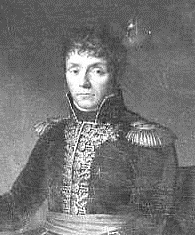
Born: November 23, 1764
Place of Birth: Saumur, Maine-et-Loire, France
Died: January 23, 1842
Place of Death: Paris, France
Arc de Triomphe: LEMOINE on the north pillar
Pronunciation:
The son of a merchant, Louis Lemoine first enlisted in the French infantry regiment of Brie in 1783. After the arrival of the French Revolution, in 1791 he was dismissed from the army but later that year he rejoined when he was elected a lieutenant colonel of the 1st Battalion of Volunteers of Maine-et-Loire. The next year Lemoine was serving at Verdun when Beaurepaire supposedly committed suicide rather than surrender the fortress, and Lemoine took over command. Next he served in Champagne and Belgium and then in September of 1793 he was promoted to général de brigade in the Army of the Alps. At the end of 1793 Lemoine was sent to the Army of the Eastern Pyrenees and he was employed in Augereau's division. In May of 1794 he served at the action of Boulou before joining Pérignon's division for a short time. That summer he returned to Augereau's division and then distinguished himself while seizing Bezalu before evacuating it. In August Lemoine fought at Saint-Laurent de la Mouga where he was wounded six times and afterwards he went on leave for four months.
In early 1795 Lemoine was transferred to the Army of the Coasts of Brest. That July he served at the attacks on the camp of Sainte-Barbe and Fort Penthièvre. January of 1796 saw Lemoine promoted to général de division in the Army of the Coasts of the Ocean and taking command of the department of Manche. In September he began serving under General Hoche for the expedition to Ireland and after the failed expedition both Lemoine and Hoche went to the Army of the Sambre and Meuse. In April of 1797 Lemoine took command of a division of the advance guard of the army and he served at the crossing of the Rhine at Neuwied. He returned to France in June and then in August he was detached from the army and sent to Paris to assist in the coup d'état of 18 Fructidor that exiled many of the royalists in the government. Next Lemoine took command of the 17th military division at Paris, replacing General Augereau, and then at the end of the year he was employed in the Army of England.
In 1798 Lemoine was sent to Italy to serve with the Army of Rome. That November he defeated the Neapolitans at Terni and then he went on to defeat them at Bosco del Popolo. In early 1799 he returned to Paris before joining the Army of Italy in April. Serving under General Pérignon, Lemoine fought at the Battle of Novi in August and afterwards he commanded a division under Gouvion Saint-Cyr. The next month he was serving in the center corps of the Army of Italy under Championnet, and he went on to serve at Genola, Mondovi, Garessio, and Ormeo. Lemoine had been openly critical of Napoleon's coup of 18 Brumaire and he was discharged in September of 1800.
In March of 1809 General Lemoine returned to the army to become commander of arms at Wesel. In February of 1813 he was named commander of Wesel and then that July he took command of the 6th Division of II Corps. Lemoine and his men were sent to Minden in August but in October they were forced to take refuge in Magdeburg. Lemoine held out in Magdeburg until after Napoleon's abdication in April of 1814. When he returned to France he was put on non-activity but also named a Knight of Saint Louis.
When Napoleon returned from exile in 1815 and resumed power for the Hundred Days, in April he gave Lemoine command of an infantry division in the III Corps of Observation. That June Lemoine took command of Mézières and he held it even after Napoleon's second abdication, refusing to surrender the citadel until he obtained guarantees for his unit to march out with the honors of war. He remained employed after Napoleon's second abdication and retired in December of 1816. Lemoine later became Baron of Loges and then Count of Loges. In 1836 at the request of King Louis Philippe Lemoine wrote a paper on the surrender of Verdun in 1792 in which he stated that Beaurepaire had been killed and had not committed suicide.
Bibliography
- Divry, Arnauld. Les Noms Gravés sur l'Arc de Triomphe. Paris: L'Harmattan, 2017.
- Six, Georges. Dictionnaire Biographique des Généraux & Amiraux Français de la Révolution et de l'Empire (1792-1814). 2 vols. Paris: Gaston Saffroy, 2003.
Updated August 2026
© Nathan D. Jensen